Guides / Cost
Plate or extrusion for a drone frame part: which stock saves money and weight
October 16, 2026
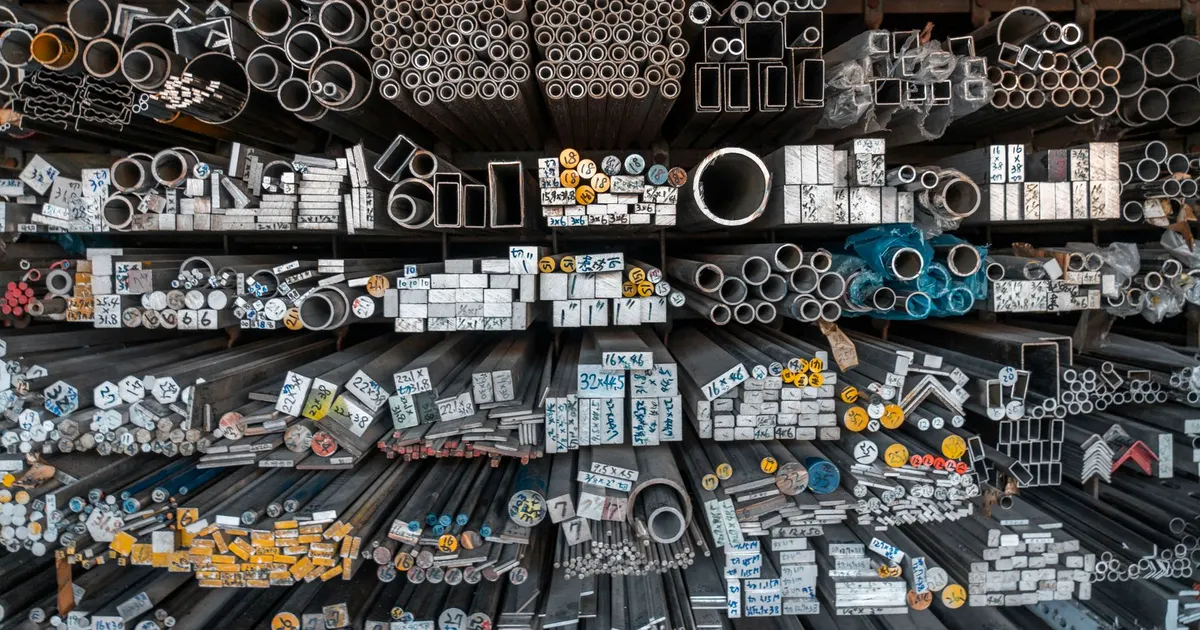
A drone arm, a boom or a frame rail can start as a flat plate, as a standard tube or as a custom extruded profile. The choice sets the material cost, the strength, the machining time and the tolerance on the finished part. Most drone programmes pick plate by default because the first prototype came out of plate, and then discover that an extrusion would have halved the cost at volume. Others pick a cheap profile and discover that the alloy is not strong enough. Stock form is one of the choices in our guide to drone parts materials.
This guide compares the two, with numbers, and a table at the end to settle the decision.
What each stock is
Plate is rolled aluminium sheet thick enough to machine, commonly 6 to 50 mm, in alloys such as 6061-T651 and 7075-T651. The T651 temper means the plate has been stretched after heat treatment to relieve residual stress. A part is cut from plate by milling, and a typical frame plate with pockets throws away 70 to 90 percent of the starting weight as chips.
Extrusion is aluminium pushed through a die to form a long profile: a tube, an angle, a channel or a custom shape. The profile has a constant cross section and comes in lengths of several metres. Most standard profiles are 6063. Structural profiles are often 6061.
Strength, honestly
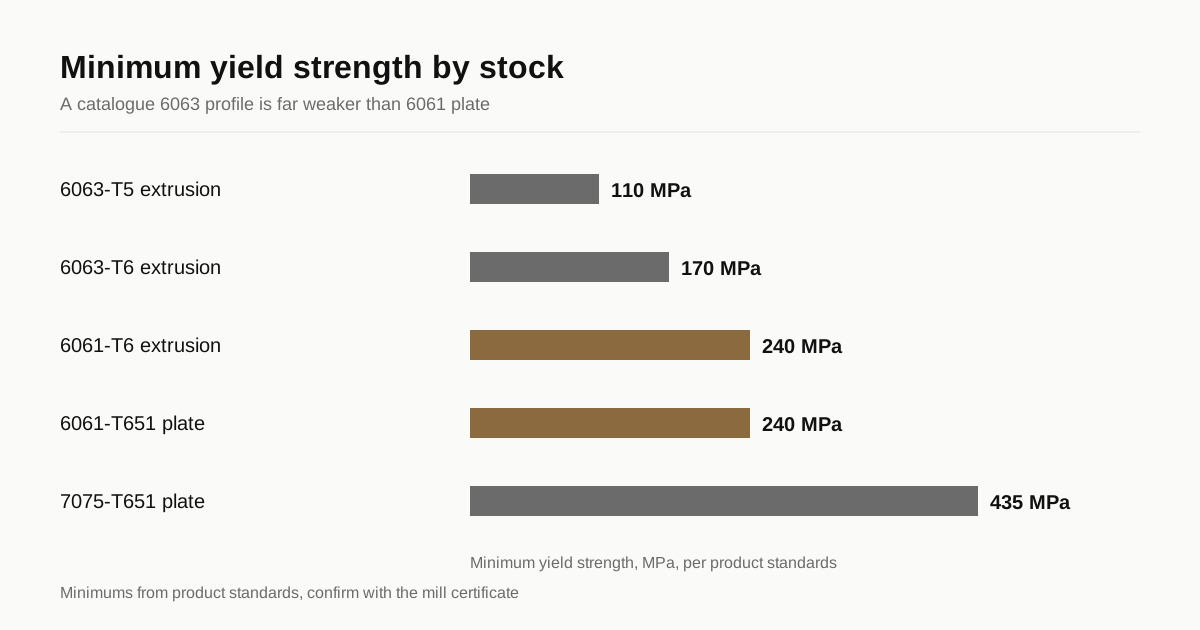
| Stock | Alloy and temper | Minimum yield, typical standard | Comment |
|---|---|---|---|
| Extruded profile | 6063-T5 | about 110 MPa | Cheap, great finish, low strength |
| Extruded profile | 6063-T6 | about 170 MPa | Better, still modest |
| Extruded profile | 6061-T6 | about 240 MPa | Structural grade, close to plate |
| Plate | 6061-T651 | about 240 MPa minimum, 276 typical | General frame parts |
| Plate | 7075-T651 | about 435 MPa minimum, 503 typical | Highly loaded fittings |
The minimum values come from the product standards for each form, such as ASTM B221 for extrusions and ASTM B209 for plate, and the mill certificate gives the actual lot values. The table shows a trap: a catalogue profile in 6063-T5 is only about 40 percent as strong as 6061 plate. A boom made from it needs a larger section or a thicker wall for the same load. The 6061 against 7075 guide covers the alloy trade-off in more depth.
Where extrusion wins
Long, constant section parts. An arm tube, a rail, a boom or a battery guide is a constant shape along its length. An extrusion cut to length and drilled at the ends is a few minutes of machining. The same part cut from plate takes hours and throws away most of the plate.
Hollow sections. A 20 mm square tube with a 1.5 mm wall is light and stiff in bending. Machining that from solid is impractical. A tube section is the efficient shape for an arm.
Volume. A custom die costs money once, and then every metre is cheap. A drone programme that makes 5,000 sets a year can justify a die. A programme that makes 200 cannot.
Where plate wins
Complex outlines. A frame plate with a custom outline, pockets, bosses and mounting patterns is a plate part. No profile gives that shape.
Mixed thickness. A part that is 3 mm thick in one area and 12 mm in another is machined from thicker plate and pocketed. An extrusion has one section.
Small quantity. Plate needs no tooling. The first piece costs the same as the hundredth, and a design change is a program edit.
Highest strength. 7075-T651 plate gives yield strength that no common extrusion matches.
Tight tolerance on the whole part. Machined plate holds plus or minus 0.01 to 0.05 mm on called features. Extruded profile tolerances are much looser.
Extrusion tolerance, and why it matters
Extruded profiles come out of the mill with tolerances set by the profile standard, such as ASTM B221 or EN 755-9. Typical points:
- Wall thickness varies by about plus or minus 10 percent or more, depending on the profile size. A nominal 1.5 mm wall can measure from 1.35 to 1.65 mm.
- Straightness is measured in tenths of a millimetre per metre, so a long profile has a bow.
- Twist can be a degree or more over a long length.
- Section size tolerances run to a few tenths of a millimetre on a 20 mm square tube.
For an arm that clamps into a machined clamp bored to a tight fit, that variation is a problem. The boom clamp guide deals with a similar question for carbon tube, and the answer is the same: machine the clamp to a fit that tolerates the tube variation, or machine the tube end to a controlled diameter.
Plate is stable by comparison. A T651 plate is flat, with low residual stress, and the machined part holds the drawing dimensions.
Cost and waste
| Item | Plate | Standard extrusion | Custom extrusion |
|---|---|---|---|
| Tooling | none | none | die, one off cost |
| Minimum order | one plate or a cut piece | one bar or a cut piece | hundreds of kilograms |
| Material waste | 70 to 90 percent on a pocketed part | under 10 percent for a cut length | under 10 percent |
| Machining time | hours for a complex part | minutes for a cut and drilled part | minutes |
| Lead time | days | days | weeks for a die plus a run |
| Design change | program edit | pick another profile | new die |
The comparison that decides it is the cost per finished part at your quantity. Chips from plate are recycled but not free: material price per kilogram applies to the whole plate, and the chips return only a fraction of it. A frame plate that weighs 200 g in the end starts as a 1.2 kg plate piece. An extruded tube arm that weighs 40 g starts at 45 g.
Grain direction and strength
An extrusion has grain along its length. The material is strongest along that axis and weaker across it. A bolt through the wall of a tube sees a load across the grain. A plate has grain along the rolling direction, with weaker properties through the thickness, and a pocketed plate loaded in the plane of the plate uses the strong directions.
For a drone arm that sees bending along its length, the grain direction of an extrusion is favourable. For a plate bracket loaded through its thickness, such as a clamp face, it is less so. Most drone parts are not so close to the limit that grain direction dominates, but it is a reason to avoid bolting a hard point through an extruded wall without a doubler.
Anodising and appearance
6063 anodises evenly and takes dye consistently, which is why it is the architectural alloy. 6061 anodises well and shows slightly more variation, especially with black dye on large faces. A visible extrusion with a seam or die line is a cosmetic point. A machined plate has a uniform finish, with tool marks that disappear under bead blast. The anodising guide covers coating growth on each.
A simple decision table
| Situation | Stock |
|---|---|
| Arm, boom or rail, constant section, volume under a few thousand a year | Standard tube or profile in 6061-T6, cut and drilled |
| Complex plate with pockets and bolt patterns | 6061-T651 plate |
| Highly loaded small fitting | 7075-T651 plate or bar |
| Cosmetic profile with low load | 6063 profile |
| Volume above a few thousand a year with a custom section | Custom extrusion in 6061-T6, then machine the ends |
| Anything needing tolerance tighter than 0.1 mm on a long section | Machine all faces from plate or bar |
The plates part family and the arm clamp family show typical parts in each stock. Material standards are listed on the material reference.
Drawing notes
- State the alloy and temper explicitly: “6061-T6 per ASTM B221” or “6061-T651 plate per ASTM B209”.
- If a standard profile is intended, give the profile size and wall.
- Mark the datum faces on an extrusion, because the profile itself is not a reliable datum.
- State which surfaces are machined and which are left as extruded.
- Give the anodise requirement, including the finish on any unmachined face.
Two worked examples
A quadcopter arm. The arm is a 20 mm square tube, 1.5 mm wall, 250 mm long, with a motor mount at one end and a clamp at the other. From a standard 6061-T6 tube, the shop cuts to length, machines the ends and drills the holes: a few minutes a piece, and the tube costs a few dollars. From plate, the same arm would be a hollow shape that cannot be made at all, so the plate route means two half shells bonded together, which is a different design. The extrusion wins clearly.
A centre plate. The plate is 200 mm across, with a custom outline, twelve pockets and a bolt pattern for the stack, motors and arms. No profile covers it. From 6061-T651 plate 6 mm thick, a piece costs hours of machining and a lot of waste, and it holds the pattern to plus or minus 0.02 mm. Plate wins clearly.
Between these cases sits a wide middle: a motor mount block, a landing leg clamp, a rail with machined pockets. These can go either way, and the quote in both stocks settles it. Ask for both if the quantity is above a few hundred a year.
Checklist before you request a quote
- Annual quantity and the first order.
- Alloy and temper required by the load.
- Whether a standard profile can meet the section.
- Tolerance on the section and on fits to clamps.
- Finish, including cosmetic faces.
- A comparison quote in both plate and profile, if the part could be made either way.
Send the model through the RFQ page, and we will quote both routes where it makes sense. We quote civil and commercial UAV parts only, and the reply comes back within 24 business hours.
Frequently asked questions
Is extruded aluminium weaker than plate?
It depends on the alloy. 6061-T6 extrusion has a minimum yield strength around 240 MPa, close to 6061-T6 plate at about 276 MPa typical. 6063 profiles, the common choice for cheap standard shapes, have a minimum yield of 110 to 170 MPa depending on temper, which is much lower. Check the alloy before comparing.
Does a custom extrusion profile make sense for a drone?
Only at volume. A new extrusion die costs money and the mill sets a minimum order by weight, usually hundreds of kilograms. Below a few thousand pieces a year, a standard profile from stock or a part machined from plate is almost always cheaper.
Which stock anodises better?
6063 gives a clean, even anodise because of its low alloy content, which is why architectural profile is made from it. 6061 anodises well too but shows slightly more colour variation with dye. For a black anodised exterior part, either works, and the difference shows mostly on large flat faces.
Need this part quoted?
Send the model and the quantity. Price and lead time come back within 24 business hours.