Guides / Materials
17-4 PH stainless on a UAV: small load-bearing parts where it earns its weight
October 7, 2026
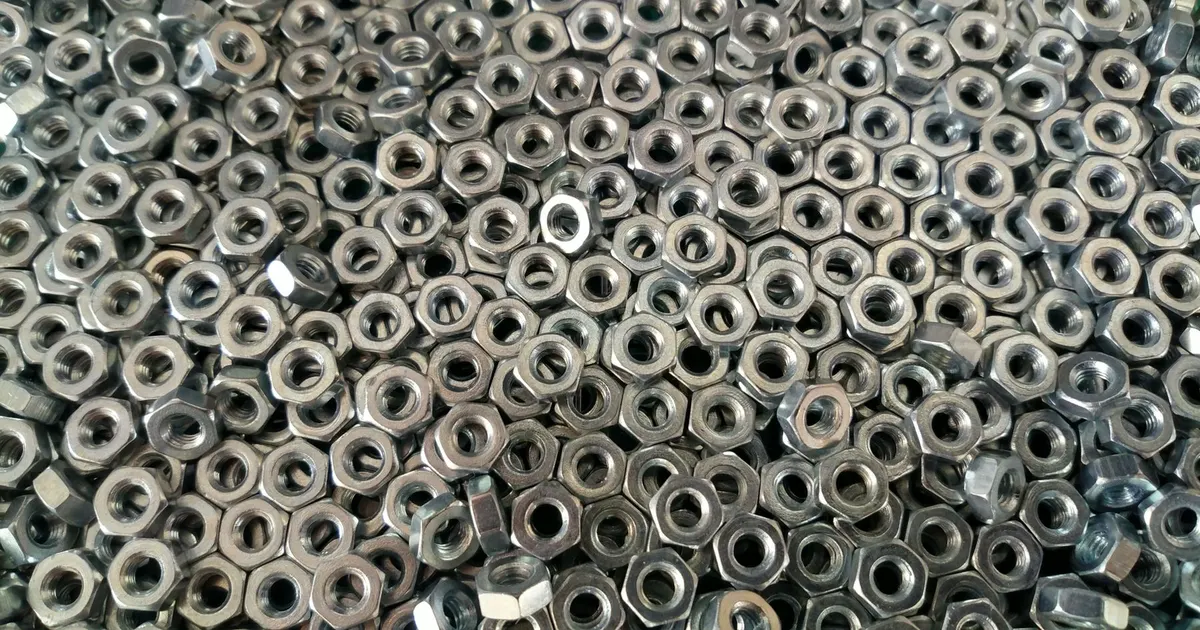
Stainless steel is the metal drone designers avoid for weight, until a part needs it. A small latch tongue, a hinge pin or a bearing seat that takes load in a space only a few millimetres wide is a case where steel’s strength beats aluminium’s lightness. 17-4 PH is the stainless grade most often chosen for it. The wider choice between aluminium, titanium, steel and plastics is in our guide to drone parts materials.
This guide explains the grade, the heat treat conditions and the drawing notes that matter, and where it makes sense against aluminium and titanium.
What 17-4 PH is
17-4 PH is a precipitation hardening stainless steel with about 17 percent chromium and 4 percent nickel, plus copper. It is machined in a soft, solution annealed state, called Condition A, and then aged at a temperature between about 480 and 620 degrees C. The ageing hardens it by forming fine precipitates inside the metal. After ageing it reaches strengths close to a medium alloy steel, with corrosion resistance close to 304 stainless.
It is magnetic, which matters on a drone with a compass. A 17-4 PH bracket near a magnetometer disturbs the reading and has to be placed away from it or replaced with a non magnetic grade.
Strength by heat treat condition
| Condition | Ageing temperature | Yield strength, minimum | Hardness, approximate |
|---|---|---|---|
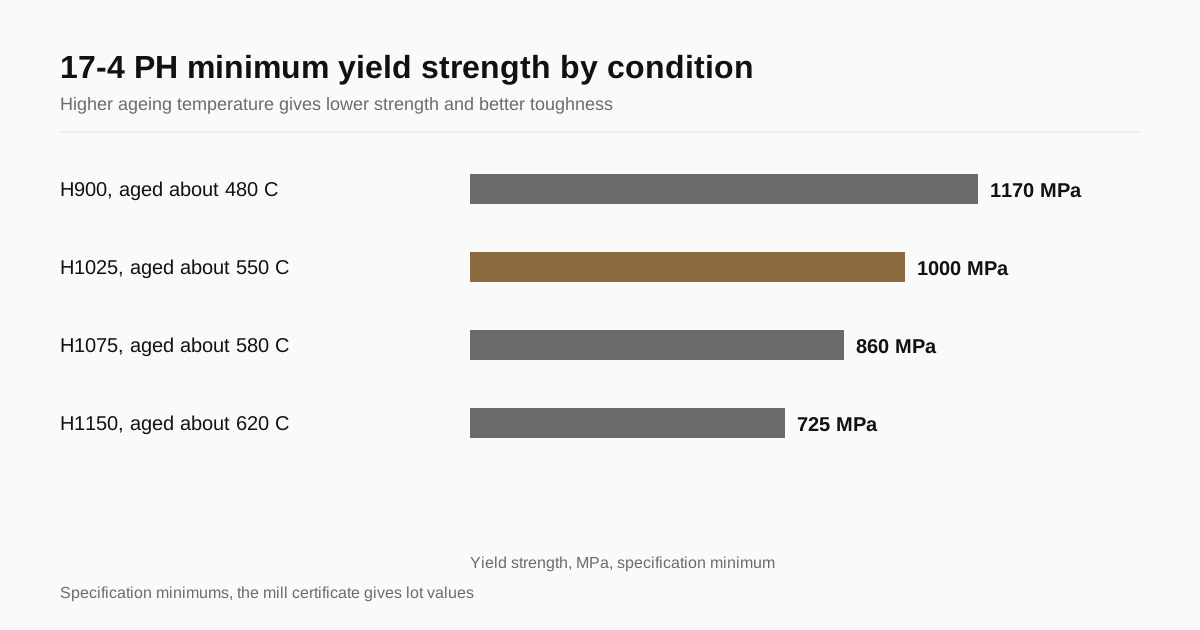
| H900 | about 480 °C | about 1170 MPa | about 40 HRC |
| H1025 | about 550 °C | about 1000 MPa | about 35 HRC |
| H1075 | about 580 °C | about 860 MPa | about 32 HRC |
| H1150 | about 620 °C | about 725 MPa | about 28 to 33 HRC |
These are specification minimum values for orientation. The standard that governs bar is ASTM A564, and the aerospace bar specification is AMS 5643. The heat treat itself follows an aerospace practice such as AMS 2759/3. The mill certificate and the heat treat certificate for your lot carry the real figures.
H900 is the strongest and the most brittle, with the highest risk of stress corrosion cracking in a marine environment. H1025 is a common compromise for drone parts. H1150 gives the best toughness and the best stress corrosion resistance, at a lower strength, and is chosen for parts that sit in damp, salty air under constant load.
Where it earns its weight
17-4 PH is about 2.8 times denser than aluminium, at 7.8 g/cm3 against 2.7. It makes sense only when the part is small and the strength requirement is high.
- Latch tongues and hooks. A battery latch or a payload hook sees repeated contact and a high load on a small edge. Steel keeps its shape, where aluminium wears and peens.
- Hinge and pivot pins where the pin runs in a bore and wears. The folding arm hinge guide explains why a harder pin in a softer bore is the right pair.
- Small gimbal shafts and bearing seats that carry radial load on a few millimetres of diameter.
- Wear plates and strike plates on a quick release.
- Fasteners and special bolts where a standard screw does not fit.
It makes no sense for plates, housings or frames, where aluminium is lighter and cheaper. The stainless against aluminium guide lists the other cases where stainless wins, which are corrosion and wear, not strength alone.
Machining order matters
The sequence for a 17-4 PH part is almost always the same:
- Rough machine in Condition A. The metal is soft and cuts relatively easily, though it is still a stainless that work hardens and wears tools.
- Leave a small allowance on tight features, because the part shrinks a little at ageing.
- Age to the specified condition. This is done by a heat treater. Heat treatment is not done in house here. It is placed with a heat treater we have used since 2019, and the certificate comes back with the lot.
- Finish machine or grind the critical features: bores, bearing seats and threads that must hold size.
- Passivate to restore the corrosion resistance of the surface.
Machining after ageing is possible, particularly in H1025 and above, but it is slower and wears tools more. Hardness near 40 HRC calls for ceramic or coated carbide tools and a rigid setup. For most small drone parts the shop machines to near size in Condition A and finishes after ageing.
Size change at ageing
The ageing reaction contracts the metal slightly. Typical values range from about 0.05 to 0.1 percent depending on the condition, with the larger shrink at higher ageing temperatures. That means a feature of 20 mm shrinks by about 0.01 to 0.02 mm.
For most features that is below the tolerance. For a bore that mates with a ground shaft at H7, or a thread that must pass a gauge, it is not. Two ways to handle it:
- Machine with an allowance based on the shrink for the chosen condition, which is a known quantity, then confirm on a first article.
- Finish after ageing by grinding, honing or reaming the critical bore, which removes the uncertainty.
Distortion is a separate matter. A thin or asymmetric part can bend in the furnace as residual stress relaxes. Rough machining first and a stress relief before finishing helps. A part that needs flatness within 0.02 mm after ageing is a part for a finish grinding step.
Corrosion and finishing
17-4 PH resists corrosion about as well as 304. It does better in air and fresh water than in a salt environment, and in a humid marine setting it can show rust staining or pitting if it is not passivated and kept clean. Practice:
- Passivate after machining, to a standard such as ASTM A967 or AMS 2700, to remove free iron from the surface.
- Prefer H1025 or above for parts in a salty environment, for stress corrosion resistance.
- Keep it away from dissimilar metals that start a galvanic cell. Stainless against aluminium is mild, and stainless against carbon fibre is gentle compared with aluminium against carbon.
- Specify a finish for the wear face: a passivated surface, a polished one or a PVD coating where the part slides. PVD is a coating placed with a processor.
What to put on the drawing
- The material: “17-4 PH bar per ASTM A564 or AMS 5643”.
- The condition: “H1025 per AMS 2759/3”.
- The point in the sequence where each feature is finished: “bore finished after heat treat”.
- The hardness range, if it matters.
- The passivation standard.
- A magnetic warning if the part sits near a compass.
Machining in practice
17-4 PH in Condition A is tough and work hardens, so the way it is cut matters more than the machine.
- Keep the tool moving. A cutter that dwells or rubs hardens the surface and then wears quickly. Constant feed and a positive rake keep it cutting.
- Use enough depth of cut. A very light skim cut rubs on the hardened skin of the last pass. A defined finish allowance of 0.1 to 0.2 mm with a sharp tool works better than a scratch pass.
- Coolant. Flood coolant at the cutting edge controls heat, which is the main cause of tool wear in stainless.
- Threads. Thread milling is gentler than tapping in this grade, and a rolled thread is stronger. Cut the thread before ageing and gauge it after, because shrinkage moves it.
- Burrs. Stainless burrs are tough and sharp. Plan a deburring step as part of the cost, and say which edges matter.
Cost compared with the alternatives
A small 17-4 PH part costs more than the same part in 7075 because of the material, the slower machining and the heat treat. It typically costs less than titanium for the same job, with higher density and lower corrosion resistance in salt. For a hinge pin or a latch tongue, a few grams of extra weight rarely changes the flight time, and the part lasts. For a bracket where a hundred grams matter, aluminium or titanium is the better call. The cost drivers guide shows how setups, material and finishing add up.
Checklist before you request a quote
- Confirm that strength in a small section is the reason for steel.
- Choose the condition: H900 for strength, H1025 as a default, H1150 for a harsh environment.
- Mark features that must finish after ageing.
- State passivation, and any coating on wear faces.
- Check the magnetic effect near the compass.
The material list shows what is kept to hand. Send the model through the RFQ page. We quote civil and commercial UAV parts only, and the reply comes back within 24 business hours.
Frequently asked questions
What does the H in H900 mean for 17-4 PH?
It stands for the ageing treatment. 17-4 PH is machined in a soft condition and then aged at a set temperature to harden it. H900 is aged at about 480 degrees C and gives the highest strength. H1025 and H1150 are aged hotter, giving lower strength and better toughness and stress corrosion resistance.
Does 17-4 PH change size when it is aged?
Yes, it shrinks slightly, roughly 0.05 to 0.1 percent depending on the condition. On a 20 mm feature that is about 0.01 to 0.02 mm. A part with a tight bore or thread is machined with a small allowance or finished after ageing.
Is 17-4 PH stainless magnetic?
Yes. It is a martensitic precipitation hardening grade and responds to a magnet. That matters on a drone that carries a magnetometer, because a magnetic part near the compass disturbs its reading.
Need this part quoted?
Send the model and the quantity. Price and lead time come back within 24 business hours.