Guides / Materials
Copper busbars and brass contacts on a drone: sizing, plating and joints
October 19, 2026
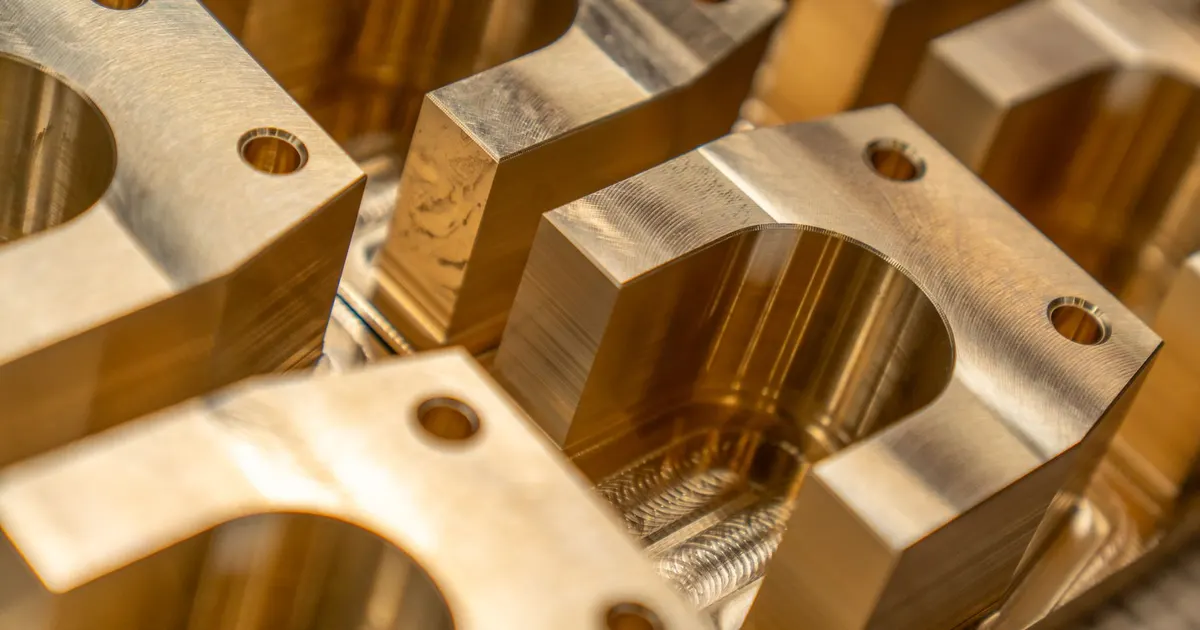
Power on a drone moves through a few thin pieces of copper. A battery that gives 100 amps in a climb needs a path for that current with a resistance of a few milliohms or less. The path might be a stamped strap, a machined busbar or a brass contact that pushes against a mating pad. All of them are parts that a machine shop makes, and all of them lose efficiency and gain heat when a joint is poor.
This guide covers sizing, material choice and the machining and plating notes that matter on drone power parts.
Material choice
| Material | Conductivity, % IACS | Density, g/cm3 | Where used |
|---|---|---|---|
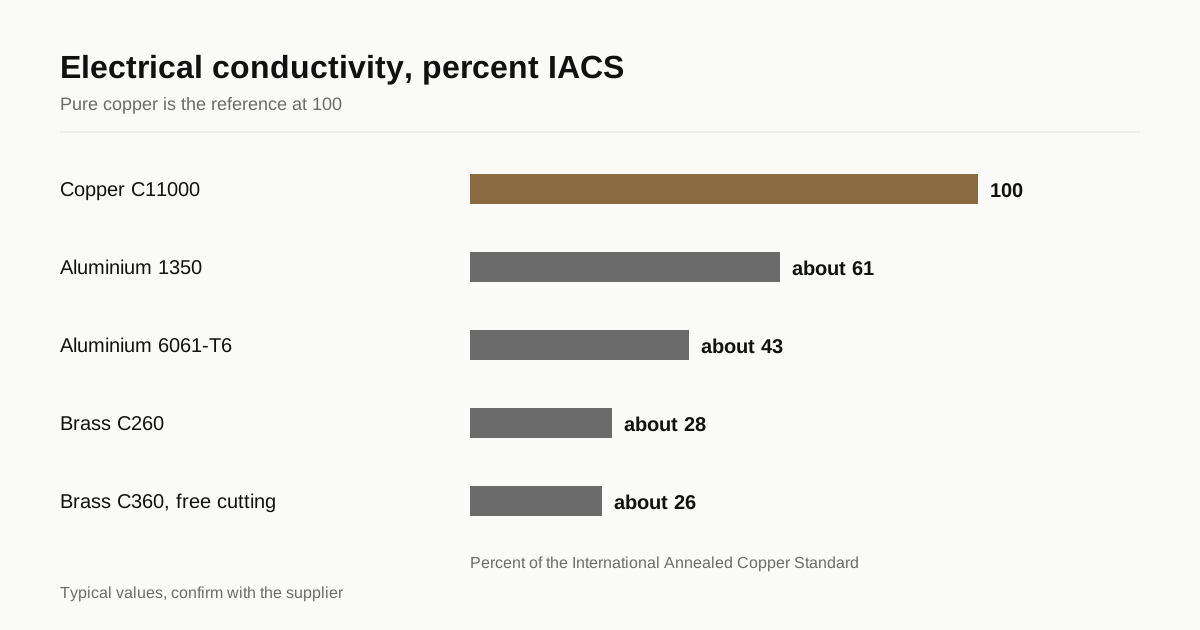
| Copper C11000 (ETP) | 100 | 8.96 | Busbars, power straps |
| Copper C10100 (oxygen free) | 101 | 8.94 | High purity or vacuum joints, rarely needed on drones |
| Aluminium 1350 | about 61 | 2.70 | Lightweight busbars on large aircraft |
| Aluminium 6061-T6 | about 43 | 2.70 | Structural parts that also carry some current |
| Brass C260 (cartridge brass) | about 28 | 8.53 | Contacts, formed parts |
| Brass C360 (free cutting) | about 26 | 8.50 | Turned contacts, pins and bushings |
IACS is the International Annealed Copper Standard, with pure copper at 100. A busbar in aluminium needs about 1.6 times the cross section of copper for the same resistance, and weighs about half as much for that bigger section. For a large aircraft with a long power run that saving counts. For a small multirotor where the busbar is 40 mm long, copper is the sensible choice and the weight is tiny.
Sizing a busbar
Current sets the cross section, and temperature rise sets how conservative that section must be. A rule of thumb for copper in still air is 1.2 to 1.6 amps per square millimetre for continuous load. A flat bar 15 mm wide and 2 mm thick has 30 mm2 and so carries about 36 to 48 amps continuous at that figure. Short bursts of a climb can run two to three times higher for seconds without trouble, because the metal has thermal mass.
A drone is not a switchboard, so the rule needs checking against the conditions:
- Airflow. A bar in the prop wash runs cooler than one in a sealed box.
- Length. A short bar loses less and heats less.
- Joint quality. A bad joint dominates. The resistance of a poorly seated bolted joint can exceed the resistance of the bar.
- Ambient temperature. A drone in the desert sun starts hot.
The numbers are typical, and a thermal test on the actual assembly is the real answer. A design review with a current profile of the flight, not just a peak, finds the problem early.
Machining copper and brass
Copper is soft and gummy. It smears under a dull tool and leaves a burr that is hard to remove. Sharp polished tools, a positive rake, plenty of coolant and a light finishing pass give a clean flat surface. Surface finish on a contact face matters for resistance, and a figure of Ra 0.8 to 1.6 is typical. A copper bar is flat within 0.05 mm over its joint face, or the joint touches on only a few points.
Brass C360 is free cutting and machines at high speed with short, clean chips. It is the standard for turned pins, contacts, bushings and spacers. Free cutting brass contains about 3 percent lead, which is allowed under a RoHS exemption for copper alloys up to 4 percent lead. Lead free brasses exist, and a drawing for a product that must avoid lead should say so. The shop gives a RoHS declaration for the materials it supplies on request.
Threads in copper are weak. Copper is soft, and a tapped thread strips at a low torque. Use a through bolt and a nut, or a brass or stainless insert, and not a tapped hole in a busbar.
Plating
Bare copper tarnishes and its surface resistance rises over months. Contact surfaces are plated to keep the joint stable:
| Plating | Purpose | Note |
|---|---|---|
| Tin | Cheap, stable contact on busbars | Common on bolted joints, can whisker in some conditions |
| Nickel | Hard barrier, wear, a base layer | Used under gold, and alone on moderate duty contacts |
| Silver | Lowest contact resistance | Tarnishes, used in dry controlled spaces |
| Gold over nickel | Stable on low current signal and small power contacts | Thin layers on connectors, costly |
Plating is placed with a plater, and is not done in house here. We machine the part to a size that allows for the plating thickness, send it to the plater with your specification and forward the processor certificate with the lot. The plating thickness adds to the part size, usually by 5 to 15 micrometres per surface for tin or nickel and less for gold, which matters on a contact that must fit a slot. The drawing says whether the dimensions are before or after plating. See the quality page for the certificates that come with a lot.
Bolted joints
A busbar joint is only as good as its clamp force and its flatness. Rules that apply to drone power joints:
- Flat, clean faces. Wipe the faces clean, and where one is bare copper, a thin layer of anti-oxidant joint compound keeps air out.
- Enough clamp force. A bolt torqued to the right value, with a spring washer or a belleville washer, keeps the force as the copper creeps over time. Copper relaxes under constant load, and the joint loosens without a spring element.
- A large washer. It spreads the force over a bigger area.
- Vibration. A drone vibrates at motor frequencies. Thread locker or a locking washer stops the bolt backing out.
- Hole edge burrs. A raised burr around a bolt hole lifts the joint faces apart. Deburr the hole edge.
The thread gauge guide gives typical torque values for small screws, and these apply to busbar bolts too.
Copper against aluminium
A busbar bolted to an aluminium frame, or a copper contact in an aluminium housing, is a galvanic couple. In dry sealed air nothing happens. In damp or salty air the aluminium corrodes, and the rate depends on the area ratio. A small aluminium part against a large copper bar corrodes quickly, because the copper is the large cathode.
Mitigations:
- Plate the copper with tin or nickel, which is closer to aluminium in the galvanic series.
- Use a bimetal washer or a tin plated aluminium interface.
- Seal the joint with a compound or a conformal coating so water does not reach the interface.
- Keep the joint inside an enclosure that is sealed or at least drained. The sealed enclosure guide covers the sealing detail.
Drawing notes
- Material and temper: “C11000 half hard” or “C360 brass”.
- Flatness on joint faces and the surface finish.
- Plating type, thickness and whether dimensions are before or after plating.
- Hole edge treatment.
- Marking location, so the polarity of a busbar is not mistaken.
- Burr free requirement on edges.
Worked example: a 60 A busbar
A multirotor draws 60 A continuous at cruise from a 12S pack and 120 A in a climb. The busbar joins the battery connector to the power distribution board over a 50 mm run.
- Cross section. At 1.5 A per square millimetre, 60 A needs 40 mm2. A flat bar 20 mm wide and 2 mm thick gives exactly that.
- Resistance. Copper has a resistivity of about 17 nano-ohm metres. A 50 mm bar of 40 mm2 has a resistance near 0.02 milliohm, which is negligible against the joints.
- Loss. At 60 A the bar dissipates 0.07 W. The joints, at 0.1 to 0.2 milliohm each, dissipate 0.4 to 0.7 W each. The joints are where the heat is.
- Mass. 50 mm × 20 mm × 2 mm of copper weighs about 18 g. An aluminium bar with 1.6 times the section weighs roughly 9 g, and saves 9 g with extra thickness and a worse joint.
The lesson is the same as in the sizing section: the bar is fine, the joints are the work. Flat faces, plating, clamp force and a spring washer decide the temperature rise, and a thermal test on the assembly confirms it. A bar that runs 20 degrees above ambient in the test is a different design from one that runs 60.
Checklist before you request a quote
- State the continuous and peak current, and the length.
- Choose copper or aluminium for the run.
- Choose plating for each contact face.
- Specify joint hardware: bolt, spring washer and torque.
- Say what the busbar touches: aluminium, carbon or a sealed housing.
- Ask for the RoHS declaration if the product needs it.
Send the model through the RFQ page. We quote civil and commercial UAV parts only, and the reply comes back within 24 business hours.
Frequently asked questions
How much current can a copper busbar carry?
A common design rule for copper in still air is about 1.2 to 1.6 amps per square millimetre of cross section for continuous load, with the lower end for enclosed spaces. Short bursts can be much higher. The real limit is temperature rise, which depends on airflow, length and joint quality.
Can copper and aluminium be bolted together on a drone?
Yes, with care. Copper against aluminium in damp air corrodes the aluminium. Plating one surface, adding a bimetal washer or an anti-oxidant joint compound, and sealing the joint all help. A dry sealed enclosure is much safer than an exposed joint.
Do you plate copper and brass parts in house?
No. Plating is placed with a plater and not done in house. We machine copper and brass to your drawing and send them for the plating you specify, with the processor certificate returned with the lot.
Need this part quoted?
Send the model and the quantity. Price and lead time come back within 24 business hours.