Guides / Materials
2024 aluminium for UAV fittings: fatigue strength against corrosion risk
October 11, 2026
2024 is the alloy of the aircraft world’s older airframes. It was the standard skin and structural alloy for decades, and it is still specified on fuselage skins, wing structure and fittings where fatigue life is the limit. It is not a common choice on small drones, which is a reason to know when it earns its place. For the other alloys and polymers on the airframe, see our guide to drone parts materials.
The short version: 2024 gives better fatigue and crack growth behaviour than 7075-T6 and more strength than 6061. It gives up corrosion resistance to get it. This guide sets out where that trade makes sense on a UAV.
What you get
| Property | 6061-T6 | 2024-T351 | 7075-T6 |
|---|---|---|---|
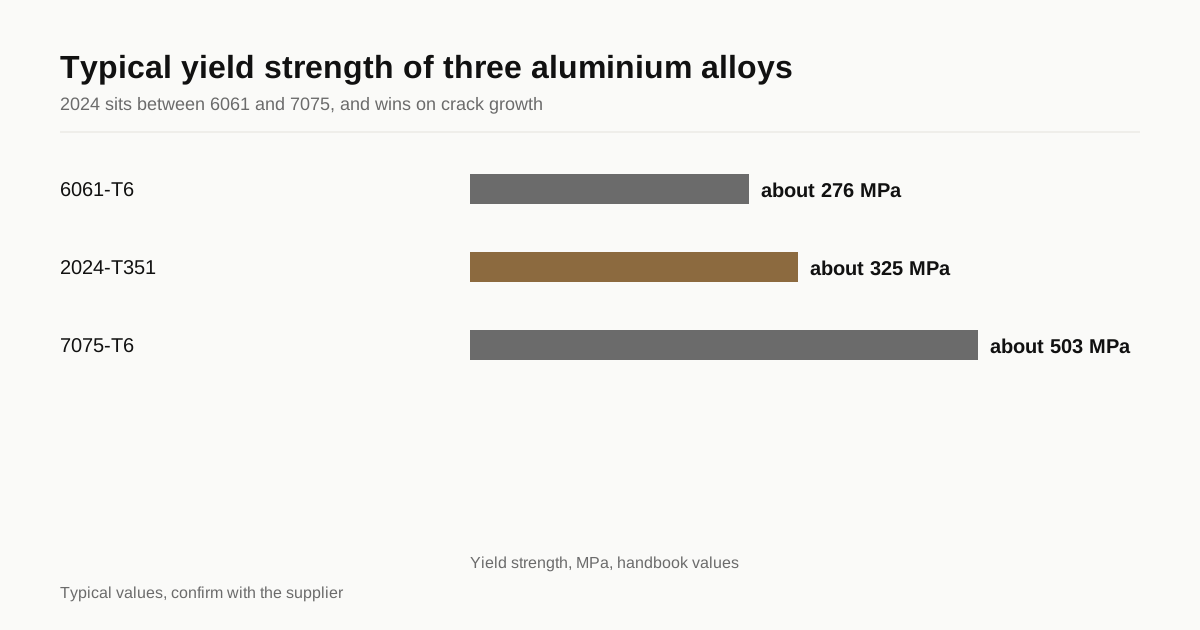
| Yield strength, typical | about 276 MPa | about 325 MPa | about 503 MPa |
| Ultimate tensile strength | about 310 MPa | about 470 MPa | about 572 MPa |
| Density | 2.70 g/cm3 | 2.78 g/cm3 | 2.81 g/cm3 |
| Fatigue and crack growth | fair | good | fair in T6 |
| Corrosion resistance | good | poor | poor to fair |
| Weldable | yes | no | no |
| Machinability | good | good | good |
These are handbook values for orientation. The mill certificate for the lot you buy governs the real figures, and the numbers vary with product form and thickness. Our material reference table lists the same alloys side by side.
Why 2024 behaves differently under fatigue
2024 carries roughly 4 percent copper, and the alloying and heat treatment give it a fine structure that resists the growth of a crack once one starts. This damage tolerance is why airframe designers chose it for tension loaded skins and fittings. 7075-T6 is stronger in static terms but cracks faster once a flaw starts, and it is more notch sensitive. A tempered 7075 in T73 improves that, with a loss of strength.
On a UAV the relevant parts are the ones that see repeated load for a long life:
- Landing gear fittings that take a hard landing many times.
- Wing attachment fittings on a fixed wing aircraft, where each flight is a load cycle.
- Hinge lugs and pivot fittings that move and carry load.
- Boom clamps on a long range survey aircraft that flies thousands of hours a year.
For a plate that is static and never sees cyclic load, none of this matters, and 6061 does the job at a lower price. See the 6061 against 7075 guide for the usual comparison.
The corrosion cost
The copper that makes 2024 fatigue tolerant also makes it corrosion prone. A bare 2024 surface in damp or salty air pits, and in some tempers it corrodes along grain boundaries. In sheet form, aerospace makes the problem go away with a clad layer of pure aluminium bonded to the surface. In machined parts there is no cladding, because machining removes it, so the surface protection is added.
For a UAV part, that means:
- Anodise it. Sulphuric acid anodising with a good seal gives 2024 usable protection. A type II layer of 10 to 15 micrometres is the usual choice for a fitting, and type III hard anodise where wear matters. The copper in the alloy makes the coating slightly less uniform than on 6061, and thickness control matters more.
- Prime the unanodised areas. A threaded hole that must stay bare, or a bonded face, needs a primer or a sealant.
- Keep it dry in storage. Parts stored in a damp place pit before they fly.
The anodising guide gives the growth and the sizing for each type. Chromic acid anodising was the older route for 2024 in aerospace, and it is restricted in many places because of hexavalent chromium, so ask what route a supplier uses.
Contact with carbon fibre
2024 and carbon fibre in contact form a galvanic cell. The carbon is the noble end and the aluminium corrodes. Copper rich 2024 is more active in practice than 6061, and the damage runs faster once water gets in. The rules for a fitting in a carbon structure are the same as for any aluminium, with less margin:
- An isolating layer such as glass cloth, a polymer washer or a bonded film between the carbon and the aluminium.
- Sealant around fasteners and at joint edges.
- A drain path so water does not sit in the joint.
The galvanic corrosion guide lists these in detail. A fitting that sits in carbon and needs both fatigue life and corrosion margin is a case for titanium, as the titanium guide explains, at a higher price.
Machining and product forms
2024 machines well, a little more cleanly than 6061 and with less gumming than 7075 in some tempers. It holds a good surface finish and takes fine edges. It does not weld. Material standards that cover it include ASTM B209 for sheet and plate and ASTM B211 for bar and rod, and a mill certificate against one of those ties the material to the numbers.
Stock availability is a practical limit. 6061 and 7075 are on the shelf in most sizes at most suppliers. 2024 is less common in small sizes and in thick plate, so the lead time for material can add days, and the minimum purchase can be larger than the part needs. Ask for a stock check at quotation, before the design is fixed.
When to pick 2024
| Situation | Pick |
|---|---|
| Static plate, frame or housing | 6061-T6 |
| Static fitting with high load, small section | 7075-T6 |
| Fitting with repeated load and a long fatigue life requirement | 2024-T351, anodised and sealed |
| Fitting in carbon structure near salt or rain | Titanium, or 2024 with full isolation |
| Welded assembly | 6061 |
The choice of 2024 follows from a stated fatigue requirement, not from habit. If the drawing does not state a life or a load spectrum, the shop cannot say 2024 is right, and 6061 or 7075 is the safer default on cost.
What to write on the drawing
- The alloy and temper, for example “2024-T351”, with the material standard.
- The finish: anodise type, seal, thickness and the masked areas.
- The isolation requirement where the part meets carbon.
- Whether a mill certificate per lot is required. It is supplied on every lot.
- The fatigue or load requirement, in words, so the shop can flag a mismatch.
What to ask before you commit to 2024
Choosing 2024 is a decision that should follow a reason on paper. Five questions settle it.
- Is there a fatigue or crack growth requirement? If the load spectrum is static or light, 6061 is enough. If a part sees thousands of load cycles at a fair fraction of its strength, damage tolerance is the reason to look at 2024.
- Is the environment dry, humid or salty? A dry, sealed or indoor aircraft is easy. A coastal aircraft needs the full anodise, seal and isolation scheme, or a different alloy.
- Will the part touch carbon fibre? If yes, plan the isolation layer at the start, not after the first corrosion.
- Can you get the stock? Ask the supplier for bar or plate in the thickness you need, with the mill certificate, before the design freezes. A part drawn around a stock size that does not exist is a redesign.
- Is there a lighter or cheaper route? A titanium fitting avoids the corrosion issue, and a 7075-T73 fitting gives better stress corrosion resistance than 7075-T6 with some strength loss.
Alternatives in one sentence each
- 7075-T6 gives the highest static strength and costs about the same, with more notch sensitivity.
- 7075-T73 trades strength for resistance to stress corrosion cracking, and is a good choice for fittings under sustained load.
- 6061-T6 is cheaper, easier to find, weldable and corrosion resistant, and is the default for most plates and housings.
- Titanium Grade 5 has excellent fatigue strength and corrosion behaviour, at a higher price and slower machining.
A stated reason keeps the drawing honest. “2024-T351 for fatigue life on a landing gear fitting” is a reason a shop can check. “2024 because it is aircraft grade” is not.
Checklist before you request a quote
- State the reason for 2024: fatigue, crack growth or a specification.
- Check stock and lead time for the product form you need.
- Choose the anodise route and seal, and note masked areas.
- Define the interface to any carbon or dissimilar metal.
- Ask for the mill certificate and the process certificate for the finish.
Send the model through the RFQ page. We quote civil and commercial UAV parts only, and the reply comes back within 24 business hours. The material list shows what we keep to hand, and 2024 is quoted on request.
Frequently asked questions
Is 2024 aluminium stronger than 6061?
Yes. 2024-T351 has a yield strength of about 325 MPa against about 276 MPa for 6061-T6. It does not reach 7075-T6, at about 503 MPa. Its real advantage is not static strength, it is resistance to crack growth under repeated loading.
Can 2024 aluminium be welded?
Not by normal fusion methods. The weld zone cracks and loses strength. If a design needs a welded joint, use 6061 and heat treat after welding. 2024 is for machined parts and riveted or bolted structure.
Does 2024 need a protective finish?
Yes. The copper in 2024 makes it more prone to corrosion than 6061, and it attacks faster when in contact with carbon fibre or when salt is present. Anodise it and seal the surface, prime it where the part is not anodised and isolate it from carbon.
Need this part quoted?
Send the model and the quantity. Price and lead time come back within 24 business hours.